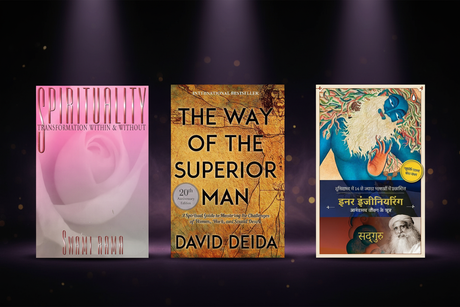
Our Spirituality & Consciousness collection is one of our largest and most eclectic, spanning karma, dream interpretation, and daily gratitude practice. Here are ten must-reads to start with.
1. 10 Rules of Wisdom — Ryuho Okawa

Ryuho Okawa, founder of the Japanese spiritual movement Happy Science, distills spiritual growth into ten core, practical rules in this compact guide. The book is written for readers who want digestible principles rather than a long philosophical treatise. Each rule is framed as something applicable to daily decisions, relationships, and self-reflection. Okawa has written extensively on spirituality, reincarnation, and the nature of the soul across a large body of work, and this title functions as an accessible entry point into his broader teachings. It sits comfortably alongside the store's wider Spirituality & Consciousness shelf as a short, structured read rather than a dense one. Readers drawn to concise wisdom literature in the vein of daily-reflection books will find its format easy to return to.
2. 10,000 Dreams Interpreted — Pamela Ball

This is a reference-style dream dictionary, organizing thousands of common dream symbols alphabetically for quick lookup. Pamela Ball has written multiple books on dream interpretation, tarot, and intuitive practice. The premise draws on the long tradition of dream symbolism found across psychology and folklore, treating dreams as a source of insight into waking concerns and relationships. Rather than a single narrative, it functions as a browsable companion book, meant to be consulted after a vivid or recurring dream rather than read cover to cover. Its scale — ten thousand entries — makes it one of the more comprehensive dream reference guides in print. It fits naturally alongside the store's Mysticism & Esoteric Traditions titles for readers curious about the language of the subconscious.
3. 50 Spiritual Classics — Tom Butler-Bowdon

Tom Butler-Bowdon is best known for his '50 Classics' series, which also includes companion volumes on psychology and philosophy — we've already featured his 50 Psychology Classics in an earlier post. This entry distills fifty of the most influential spiritual and self-discovery texts, from ancient scripture to modern memoir, into concise summaries. Each chapter introduces the original work, its author, and its central argument, functioning as a guided map through centuries of spiritual writing. It's designed for readers who want a broad overview before committing to full original texts like the Tao Te Ching or the Bhagavad Gita. Butler-Bowdon's writing is accessible and journalistic rather than academic, which has made the series popular with general readers. For anyone building a personal spiritual reading list, this is a practical starting map.
4. 21 Days to Find Success and Inner Peace — Wayne Dyer

Wayne Dyer was one of the most influential self-help and spiritual authors of the late 20th and early 21st centuries, known for bestsellers like Your Erroneous Zones and The Power of Intention. This book structures its guidance as a 21-day programme, a format Dyer used across several of his later works to make personal transformation feel achievable in stages. It blends practical self-help advice with the more overtly spiritual, intention-focused philosophy that defined his later career. Dyer drew heavily on Eastern philosophy, particularly Taoist thought, in much of his writing, and that influence runs through this book's approach to inner peace. His work reached a very wide mainstream audience through PBS specials and bestseller lists, making him one of the more recognizable names in Western spiritual self-help. This title suits readers who want structured, day-by-day guidance rather than an abstract philosophical read.
5. 108 Seeds of Spiritual Wisdom — Gian Kumar

This collection presents 108 short spiritual reflections — a number with deep significance in Hindu and Buddhist tradition, echoed in the 108 beads of a mala. Gian Kumar writes in the Indian self-help and spiritual guidance tradition, aiming each 'seed' as a standalone, digestible piece of wisdom. The format favours short daily reading over sustained narrative, making it suitable for a morning or evening reflection practice. It sits within the Awareness & Conscious Living strand of the store's Spirituality collection, alongside other mindful-living titles. Books structured this way are typically meant to be revisited repeatedly rather than read once. Readers who enjoy short-form spiritual writing in the style of daily meditations will find this format familiar.
6. 12 Laws of Karma — Manhardeep Singh Ahluwalia

This book breaks down the traditional concept of the twelve laws of karma into individually explained principles. Manhardeep Singh Ahluwalia writes for a general audience interested in applying karmic philosophy to everyday choices rather than purely religious study. The twelve-laws framework has circulated widely in popular spiritual writing for decades, drawing loosely on Hindu and Buddhist ideas about cause and consequence. Each law is typically illustrated with real-life-style examples to make an abstract concept concrete. It's published by Bloomsbury, reflecting the mainstream popularity this genre of accessible karmic philosophy has achieved. This pairs naturally with the store's other Spiritual Awakening titles for readers exploring cause-and-effect spiritual frameworks.
7. 12 Laws of the Universe — Harinder Sra

This book presents twelve spiritual principles said to govern energy, intention, and personal transformation, in the same popular 'universal laws' genre as titles like the Law of Attraction. Harinder Sra writes for readers interested in applying these laws practically to manifestation and self-development. The genre draws on a blend of New Age thought, Eastern philosophy, and popular psychology that has become widely read over the past two decades. Structured explanations of each law typically make it easy to reference individual concepts rather than reading linearly. It's a Bloomsbury title, again reflecting how mainstream this style of accessible universal-law writing has become. Readers who enjoyed 12 Laws of Karma above may find this a natural next read.
8. 21 Days to Understand Qabalah — David Wells

Qabalah (also spelled Kabbalah) is a body of Jewish mystical teaching centered on the Tree of Life, a symbolic map of divine emanation and human consciousness. David Wells introduces this complex tradition through a structured 21-day format, breaking a historically dense subject into manageable daily lessons. It's published as part of Hay House's structured '21 Days' series, which applies the same day-by-day format across many spiritual topics. The book is aimed at beginners rather than practicing Kabbalists, prioritizing accessibility over comprehensive scholarship. Qabalistic symbolism has influenced esoteric traditions well beyond Judaism, including tarot and Western occultism, which is likely why it sits within the store's Mysticism & Esoteric Traditions shelf. It's a solid entry point for readers curious about Kabbalah who don't yet want a full academic text.
9. 365 Sayings of Prophet Muhammad — Abdur Raheem Kidwai

This book compiles a year's worth of daily sayings (hadith) attributed to the Prophet Muhammad, organized for one reading per day. Abdur Raheem Kidwai is a scholar of Islamic studies who has written and translated multiple works on Islamic literature and theology. The daily-reading format mirrors similar year-long compilations from other faith traditions, like 366 Gems from Buddhism and 366 Gems from Hinduism elsewhere in this collection. It functions as a devotional and reflective text rather than a narrative one, meant to be read a page at a time across the year. Hadith collections form a central part of Islamic teaching alongside the Quran, guiding practice and ethics in daily life. This is a straightforward, structured way for readers to engage with Islamic teachings incrementally.
10. 52 Weeks of Gratitude — Ink & Willow

This is a guided journal rather than a book to read straight through, structured around one reflective prompt per week for a full year. It's published under Ink & Willow, an imprint focused on faith-based journals and reflective writing tools. The gratitude-journaling format has a well-documented history in positive psychology research linking regular gratitude practice to improved wellbeing. Its weekly (rather than daily) pacing makes it a lighter commitment than some other year-long practices in this collection. The book blends prayer, reflection, and simple recording of thankfulness, positioning it at the intersection of devotional practice and modern wellness journaling. It's a practical, hands-on pick for readers who want to actively build a habit rather than only read about one.